
Guides
Tutoring center quote template: nine sections and arithmetic slots for owners
A tutoring center quote template with nine sections, the arithmetic slots, two worked structures without figures, and the language to avoid in quotes.
What to take away
- This page carries no dollar figures. Prices for tutoring are local, and a specimen number would be wrong for almost every reader and would be copied anyway.
- What it gives instead is the skeleton of a written quote, with the wording for each section and the arithmetic slots you fill from your own floor.
- A quote is the document a family reads twiceonce when deciding and once when unhappy. Write it for the second reading.
- The three sections that prevent nearly all later disputes are the make-up rule, the expiry, and what happens if the family stops.
Why a quote and not a price list
A price list answers a question the parent has not asked yet. They arrived with a problem about a specific child, and a list of hourly rates makes them do the translation themselves.
A quote does the translation. It says what you observed, what you propose, how many sessions over what period, what it costs, and what happens if things change. It also gives you a written record of what was agreed, which matters months later when somebody remembers it differently.
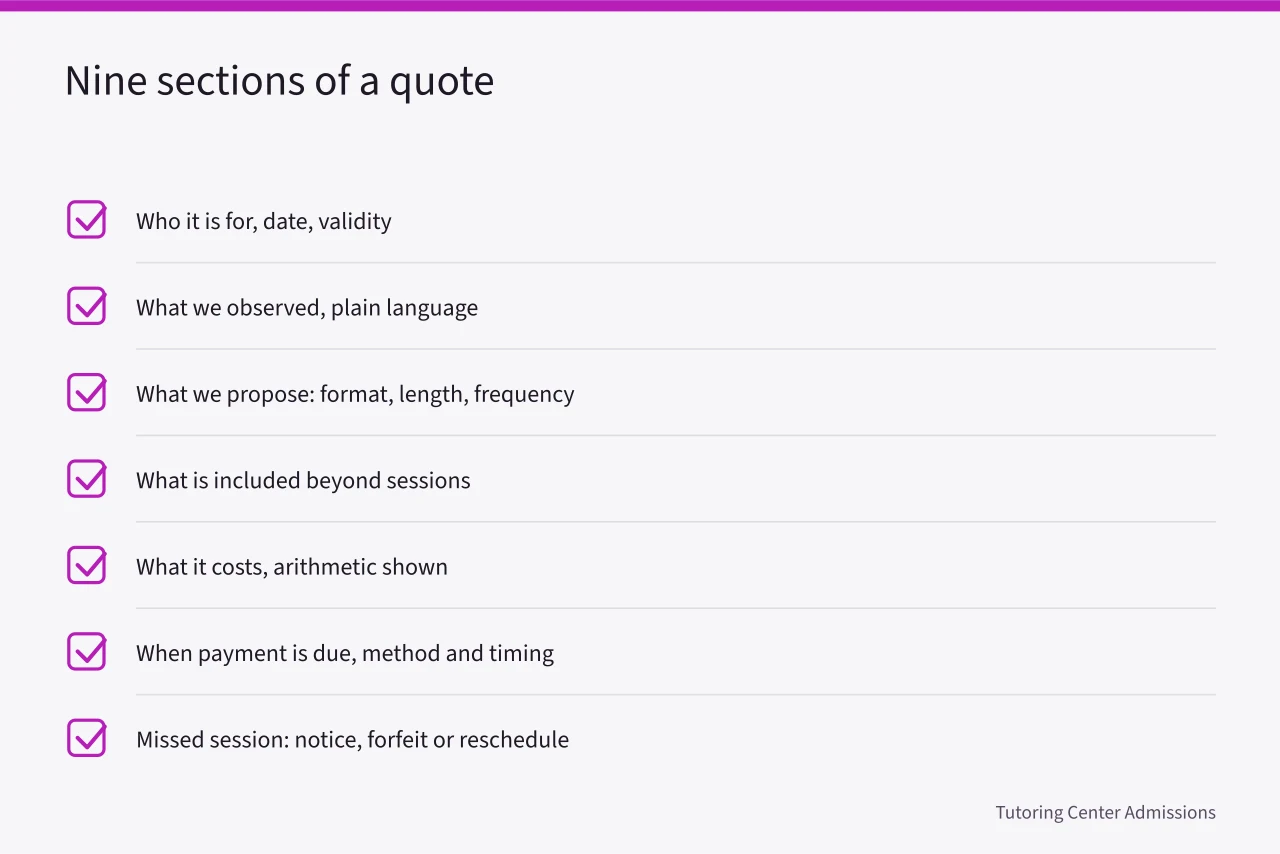
The nine sections
- Who this is for and when it was written.Student's first name, the date, and a validity period. A quote with no expiry is an open offer at last year's price.
- What we observed.Two or three sentences from the assessment, in plain language, with no diagnosis and no label. This is the section parents actually read.
- What we propose.Format, session length, frequency, and duration. Say whether it is one-to-one or a group, and if a group, the maximum size.
- What is included beyond the sessions.The written progress report, the parent meeting, any materials. Name them, because otherwise they are invisible and unvalued.
- What it costs.The unit, the number of units, and the total. Show the arithmetic rather than only the total.
- When payment is due.Up front, in installments, or per session. State the method and the timing.
- What happens if a session is missed.The notice period, whether a missed session is forfeited or rescheduled, and into which hours a make-up may go.
- How long the hours last.The expiry, stated as a date rather than as a duration, so nobody has to compute it.
- What happens if you stop.Notice required, and what becomes of unused hours. Say it plainly in the quote rather than burying it.
Sections seven, eight and nine are the ones families skim and the ones that generate every difficult conversation. Put them on the same page as the price, in the same size type.
The arithmetic slots
Show the calculation rather than a single number. It makes the quote checkable and it makes a later question easy to answer.
Arithmetic slots in a quote
- Unitsession length and format
- Unit priceyour price for format
- Number of unitssessions per week times weeks
- Subtotalunit price times number of units
- Included itemsreport, meeting, materials
- Adjustmentdiscount with stated reason
- Totalamount due
- Payment scheduledates and amounts
| Slot | What goes in it | Where it comes from |
|---|---|---|
| Unit | The session as you actually schedule it, with length and format | Your catalog |
| Unit price | Your price for that format | Your own floor plus your market judgment |
| Number of units | Sessions per week multiplied by weeks | The proposal in section three |
| Subtotal | Unit price multiplied by number of units | Arithmetic, shown |
| Included items | Report, meeting, materials, priced at zero if included | Section four |
| Adjustment | Any discount, with a stated reason | Your discount policy, not an improvisation |
| Total | The amount due | Arithmetic, shown |
| Payment schedule | Dates and amounts | Section six |
The adjustment row deserves a note. A discount with a stated reason, such as a term commitment, is defensible and repeatable. A discount with no stated reason becomes the price for that family permanently and travels quickly among parents at the same school.
Two worked structures, without figures
A worked example: a term commitment
Unit is a 50-minute one-to-one session, units run one per week for the term's teaching weeks, and subtotal is unit price times that count.
Term commitment vs flexible block
Term commitment
- Unit
- 50-min one-to-one
- Units
- One per week for term
- Included
- Report, meeting, reduction
- Payment
- Three equal installments
- Missed sessions
- Rescheduled within term
- Expiry
- Term's last teaching day
Flexible block
- Unit
- Same session
- Units
- Family chooses block size
- Included
- No adjustment
- Payment
- In full at purchase
- Missed sessions
- Return to balance
- Expiry
- Stated date, usually year end
Included are one written report at term end and one parent meeting, plus a stated term-commitment reduction. Payment is three equal installments on stated dates. Make-up sessions missed with stated notice are rescheduled within the term, not past it, and expiry is the term's last teaching day.
A worked example: a flexible block
Unit is the same session, the family chooses the block size with no adjustment, and payment is in full at purchase.
Missed sessions with notice return to the balance, and expiration is a stated date, usually the school year's end. If you stop, unused hours follow your stated policy, and the quote reproduces it rather than references it.
The second structure is easier to sell and harder to schedule. That trade-off is priced rather than argued about, and the reasoning is in the pricing and profit guide for tutoring center owners.
Filling in the unit price honestly
The unit price is not a number you find. It is your floor plus a judgment about your market.
Building the unit price floor
- Tutor cost
- Paid hours that are not sold
- No-show rate
- Fixed costs the session consumes
Build the floor from tutor cost, the paid hours that are not sold, the no-show rate, and the fixed costs the session consumes.
The step-by-step method is in pricing tutoring sessions from the cost up. The phase-by-phase view of whether those prices cover the year is in break-even across a tutoring center's school year.
Tutor cost, the largest input, is set by your local labor market rather than by what seems fair. The Bureau of Labor Statistics publishes occupational employment and wage estimates by area, which is the honest way to see how far apart two markets are before assuming a price from elsewhere transfers.
Language to avoid in a quote
Do not write anything that promises a result. Not a grade, not a score, not an admission, not an improvement expressed as a number.
Language to avoid in a quote
- No promised grade
- No promised score
- No promised admission
- No improvement expressed as a number
- No diagnostic language or labels
Claims have to be truthful and supported, and endorsements have to reflect honest experience, as the Federal Trade Commission's advertising guidance for small businesses sets out. A quote is advertising as much as a web page is. Write what you will do, how often, and how you will report on it.
Avoid diagnostic language as well. Describe what the student did on the assessment. Leave labels to the professionals qualified to apply them.
What the quote commits you to operationally
Everything in section four is a standing obligation, and a promised report requires report-writing time in someone's week.
Operational commitments of a quote
- Report-writing time in someone's week
- Promised materials in stock
- Format deliverable in the room
- Keep a copy of every quote as issued
Promised materials must be in stock, a purchasing decision rather than a marketing line, covered in the equipment checklist for new tutoring center owners.
A promised format must be deliverable in the room at the hours you sold. That depends on layout decisions in the equipment and setup guide for a tutoring center.
Keep a copy of every quote as issued, with its date. The general expectations for documenting business transactions sit in the IRS material on the records a business should keep, and a quote is the document that explains every later invoice.
Common questions
Should the quote show an hourly rate?
Show the unit and its price, then the arithmetic. Families compare rates between centers regardless, and hiding it reads as evasive.
How long should a quote stay valid?
Long enough for a family to discuss it and short enough that it does not survive your next price change. Put the date on the document.
Should the assessment findings go in the quote?
A short, plain summary, yes. It is the part that makes the proposal make sense. Keep it descriptive and avoid any language that reads as a diagnosis.
What if a family asks for a discount you do not offer?
Give them a reason your price is what it is, and if you do move, attach the movement to something they give you in return, such as a term commitment. A discount with nothing attached will be repeated to other parents.