Guides
Tutoring center equipment checklist: three lists
Use this tutoring center equipment checklist to choose opening purchases, plan additions after the first term, and defer items until sessions show a need.
What to take away
- This tutoring center equipment checklist gives you three lists: what you cannot open without, what you will want by the end of the first term, and what you should deliberately not buy yet.
- The third list is the one that saves money. Most of what a new owner is tempted to buy in July turns out to suit a center they do not end up running.
- Every item on the opening list exists to make a session start on time, be supervised, and be recorded. Anything that does none of those three can wait.
- Buy the folders and the storage before the technology. It is the least exciting purchase and the one that fails most visibly when it is missing.
Cannot open without it
- Seating and working surfaces for your peak headcount, in the sizes your actual age range needs
- A sign-in point that is not the same surface as payments and paperwork
- A folder per student, and storage for them that a tutor can reach without crossing a session
- Whatever your supervision layout requirespartitions, glass, or an open plan that keeps every student visible
- A writing surface within reach of each working area
- Somewhere for parents to sit, out of earshot of sessions
- A phone that can be answered and deliberately diverted
- A way to take a payment, and a way to issue a receipt
- Basic first aid, and a clear route to the exit from every seat
Nine items. If something is not on this list and you are about to buy it in the weeks before opening, ask which of those three jobs it does.
Nine opening essentials
- Seating for peak headcount
- Separate sign-in point
- Student folders and reachable storage
- Supervision layout keeps all visible
- Writing surface within reach
- Parent seating out of earshot
- Phone answered and diverted
- Payment and receipt method
Wanted by the end of the first term
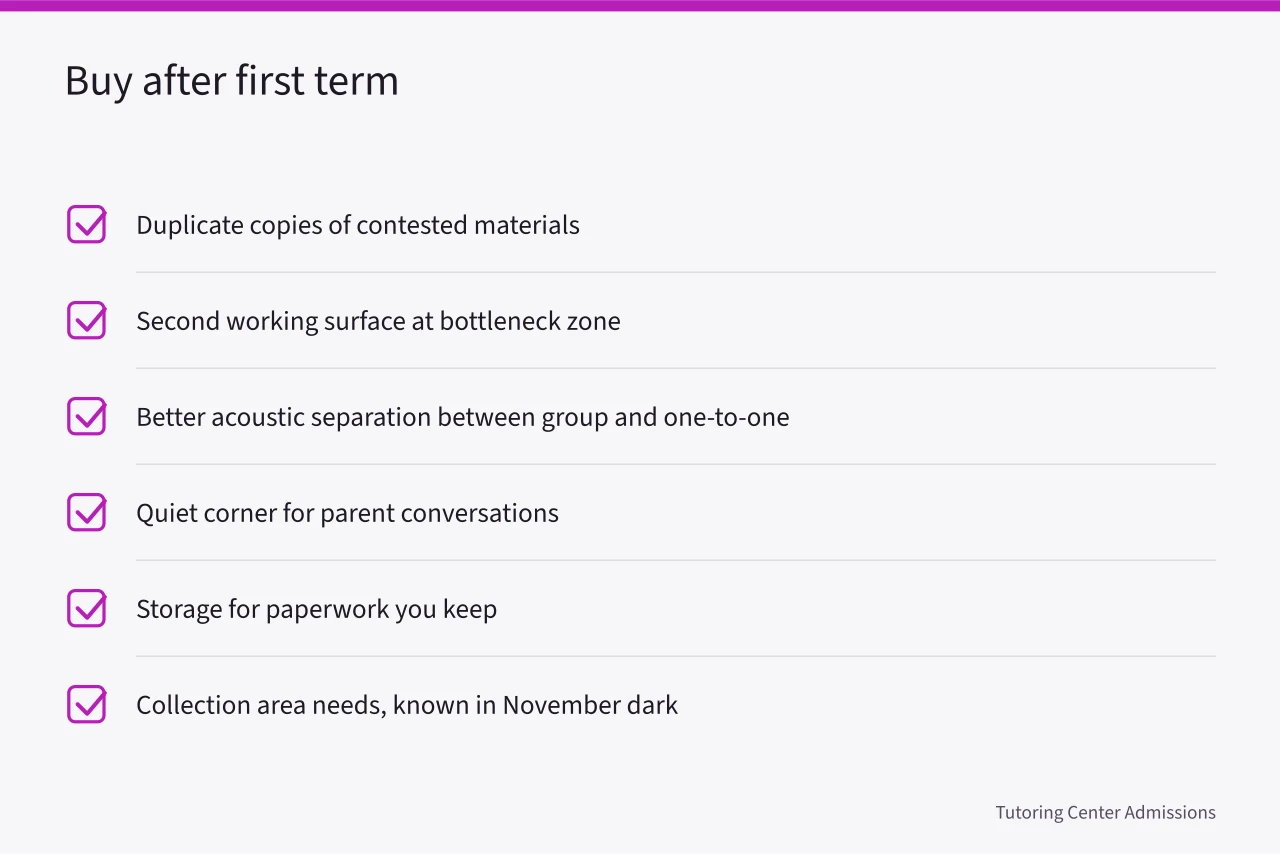
- Duplicate copies of the worksheets, books, or manipulatives your busiest sessions fight over
- A second desk or table in whichever zone turned out to be the bottleneck
- Movable acoustic screens between group and one-to-one work, positioned without blocking sightlines or exits
- A small table and chairs in a quiet corner for conversations with parents
- A lockable filing cabinet or labeled storage bins for the paperwork you have discovered you keep
- Task lighting or a clearly visible collection-area sign, but only if watching the area shows that is what it needs
The last one is worth waiting for. Collection in September and collection in December are different problems, and lighting or signage bought in advance is usually bought for the wrong one.
Deliberately do not buy yet
Some purchases feel like preparation and are actually a bet on a center you have not opened.
Tempting purchases to delay
Tempting purchase
- Device for every seat
- Method depends on screens
- Group tables for full room
- Can staff peak groups
- Branded fit-out
- Name and mix settled
- Large curriculum order
- Know student levels
- Second printer or screen
- First is bottleneck
What it assumes
- Device for every seat
- After tutors asked
- Group tables for full room
- After group runs at minimum
- Branded fit-out
- After one enrollment window
- Large curriculum order
- After assessments tell you
- Second printer or screen
- After a month as bottleneck
When it is right
- Device for every seat
- Group tables for full room
- Branded fit-out
- Large curriculum order
- Second printer or screen
Don't buy a laptop or tablet for every seat until teaching depends on screens. Don't buy group tables and matching seating for a format you cannot staff. Wait on branded wall graphics or other permanent fit-out until your name and service mix settle through one enrollment window, and don't buy curriculum sets in bulk before you know your students' levels.
Resist a second printer, screen, or anything until the first has been the bottleneck for a month.
What it quietly assumes
- A device for every seat
- Your method depends on screens
- Group tables for a full room
- You can staff group sessions at peak
- Branded fit-out
- Your name and service mix are settled
- A large curriculum order
- You know your students' levels
- A second printer or screen
- The first one is the bottleneck
When it becomes the right buy
- A device for every seat
- After a term in which tutors asked for them
- Group tables for a full room
- Once a group has run at its minimum for a term
- Branded fit-out
- After one full enrollment window
- A large curriculum order
- Once the assessments have told you
- A second printer or screen
- After it has actually been the bottleneck
The rule that catches all of these: if you cannot name the session next week that fails without it, it is not an opening purchase. What each format actually needs, and how the room should be arranged around it, is set out in the equipment and setup guide for tutoring center owners.
The folder question
Every student needs a physical or digital place holding what they did last week, what they found hard, and what comes next.
That folder is the thing that turns a set of individual tutors into a center. It is also what lets a substitute pick up a session without the student having to explain their own history. Buy the storage, put it where the tutor starts the session, and make retrieving it part of the handover rather than something to do later.
Because the folder holds a minor's information, decide who can open it and where it stays overnight.
The Family Educational Rights and Privacy Act (FERPA) covers education records maintained by educational agencies and institutions receiving funds from the U.S. Department of Education. The Department of Education's student privacy resources describe that federal framework.
FERPA does not automatically cover an independent tutoring business simply because it works with minors. It may apply when a provider handles education records for a covered school under the school's direct control; state student-privacy laws and the district contract may impose additional duties. There is no nationwide federal tutoring-center license or national register. Check your state's business-registration office and education agency, the city or county business-licensing office, and the state's child-care licensing agency if your program may fall under its rules. The applicable authority and filing depend on location and services; the licensing and compliance guide covers those location-specific questions.
Safety items that are easy to skip
Look for the hazards that only exist during the block, because an empty room in the morning looks safe.
OSHA's Recommended Practices for Safety and Health Programs describes a proactive approach: find and fix hazards before an injury or inspection does. At a tutoring center, that means securing cables wherever devices are used, choosing stable furniture for rooms used by younger children, keeping an exit route clear from every seat once tables are in place, and providing lighting where students leave the building.
Add the walk itself to your opening list. It takes twenty minutes and it is the cheapest item here.
What the staff need, physically
Tutors need to arrive, find their students, teach, and write a note before leaving. Each of those needs somewhere to happen.
A place to leave a bag and a place to see the day's grid. Materials within reach of the room they are used in, plus a surface for writing a note in the two minutes after a session. A note that requires walking to the staff room will not get written.
Those requirements come from the onboarding and shift design described in the hiring and training guide for tutoring center owners.
What the front of house needs
The parts of the building families see are doing marketing work whether or not you intend them to: the entrance, the waiting area, the noticeboard, and the desk.
Keep them clean and legible rather than impressive. What a family is judging is whether this place is organized, because organization is a proxy for whether their child will be looked after. How that fits the wider picture families form of a center is covered in the marketing and growth guide for a tutoring center.
One caution. Whatever you display must be true. Claims have to be truthful and supported, as the Federal Trade Commission's Advertising FAQs: A Guide for Small Business explains, and a wall of results in a waiting area is a claim like any other. Display your method, your qualifications and your process rather than outcomes you cannot substantiate.
When to buy the rest
At the end of the first term, walk the building during the block and note every point where somebody waits or fetches. That list is your second purchase order, and it will be shorter and more accurate than anything you could write now.
The order in which sessions and arrivals actually flow through the building, which decides where those bottlenecks appear, is described in the operations and workflow guide for tutoring center owners.
Common questions
How much should a new center spend on equipment?
There isn't a defensible flat amount: room size, existing furnishings and local prices change the total. Price each item on the opening list with local suppliers, then budget separately for first-term additions. Hold off on deferred purchases until actual sessions show a need.
Is it worth buying a large interactive display?
Only if your teaching genuinely uses one. In a center where work happens between two or three people at a table, a small writing surface within arm's reach is used far more.
What about materials and curriculum?
Buy enough for the levels you know you have, and buy more when you know what your roster actually looks like. Bulk purchases made before enrollment routinely miss the levels that turn up.
What is the one item new owners regret not having on day one?
Storage for student folders, placed where the tutor starts. Everything else can be improvised for a week; that cannot.